Feelings and Resiliency

Feelings and Resiliency

My full time job has been marked with lots of feelings this year.

My company has had 15 – 20% headcount reductions (read as layoffs).

I was in the first round of reductions. Thankfully, I am still gainfully employed.

That is not true for many people, including the team I was a part for the last 2 years.

My former team’s positions were eliminated entirely. At the end of the first round, 2 teammates elected to retire or voluntarily leave; 4 were left standing (meaning they were laid off); and 3 of us were placed in other positions.

How rapidly it all happened was shocking. One day we were a team and the next I would not see some of my team members anymore.

Corporate world can be and is brutal. I’ve personally experienced headcount reductions 4 times in my 14 year career so far. I’m certain there will be more.

Beginning at the end of 2024, my team and others began preparing employees for what was coming.

The uncertainty that lingers for months in advance of knowing if you have a job or not is stressful!

We lean on tools to strengthen our resiliency during these times. These tools equip us for what will ultimately come. They remind us to be flexible and lean into strengths. Focus on what we can control and loosen our grip on what we cannot.

They are good reminders during this time. And while these tools don’t take away the hardship of enduring one of these reductions, it can help shift our mindset..

In February of 2025, I gave a presentation about Feelings and Resilience. Here is what I shared.

Referring to the Feeling Wheel, if you had to name the feeling(s) you have right now, what would it be?

Are you surprised that there are so many feelings? And yet, they can connect back to 6 core feelings.

What feelings do you tend to ignore?

Do you think it’s possible to ignore “bad” feelings and only experience “good” feelings? Why or why not?

Early this year, I finished reading Brene Brown’s book, The Gifts of Imperfection.

What I didn’t know before I read the book was how much resiliency is incorporated into imperfection.

Brene writes, when we become more accepting of uncomfortable feelings, we become more flexible and can enjoy life more fully even with feelings of discomfort.

In her book she notes:

  • Shame, guilt, fear, despair, disappointment, and sadness are difficult feelings that tend to cause vunerability, discomfort, and pain.
  • The most powerful feelings we experience have very sharp points, like the tip of a thorn.
  • Which usually leads to modes of distraction to get away from the uncomfortable feelings. Such as…mindless scrolling, eating, drinking, shopping, staying busy, work, choas, etc.

Everyone moves away from feelings of discomfort.

We also must remember that we cannot selectively ignore feelings.

“When we numb the dark, we numb the light.”

We can’t make a list of “bad” feelings and say, “I’m going to ignore these” and then list the positive feelings and say, “I’m going to fully engage in these!”

It doesn’t work that way.

Let’s explore the feeling of Joy.

To love and/or believe in something with your whole heart; to engage in a life that doesn’t come with guarantees…these involve the risk of vulnerability and often pain.

AND

Great joy can come from them.

Feelings of hopelessness, fear, blame, pain, discomfort, vulnerability, and disconnection sabotage our resilience and well being.

The only experience broad and fierce enough to combat a list like that is the belief that we’re all in this together and that something greater than ourselves has the capacity to bring love and compassion into our lives.

Practicing spirituality is what brings about healing and creates resilience.

Spirituality is being able to adhere to beliefs, principles or values needed to persevere and prevail in accomplishing missions.

Here is an example of the ways I’ve leaned into my spirituality practice.

Having a sense of purpose, meaning, and perspective in our lives allows us to develop understanding and move forward. Without purpose, meaning, and perspective, it is easy to lose hope, numb our emotions, or become overwhelmed by our circumstances.

We feel reduced, less capable, and lost in the face of struggle. The heart of spirituality is connection and through that, we won’t feel alone.

How do you know that you are ignoring uncomfortable feelings?

Recognizing and leaning into (not away) from discomfort of vulnerability teaches us how to live with joy, gratitude, and grace.

We live in a both/and world.

We can experience discomfort and joy. They are not mutually exclusive.

When you have the awareness, what can you do to practice leaning into the discomfort?

How can you lean into the discomfort of vulnerability and let joy in as well?

Exercise Prompt:

Hold up both hands, palms up and open. Can you practice holding the feelings of discomfort in one hand and the “good” feelings in the other hand? In fact, write on one open palm your feelings of discomfort and then write the “good” feelings on the other open palm. Practicing holding and experiencing both.

12 Reasons to Keep a Journal

12 Reasons to Keep a Journal

I was just in my prayer journal and reading through the last few entries. One paragraph in an entry expresses how I feel like I’m wandering through the wilderness. It’s much like what the Israelites did, (Deuteronomy 29:5-6). I feel like I’m wandering because where I work full-time is restructuring the entire company, which includes headcount reductions (layoffs). I wrote about one of the ways I’m navigating this uncertainty last week. I’m in the middle of the unknown and living in an in-between place. The ways I’m choosing to battle through this is reminding myself of what is true. Did you know that truth telling = confession? To confess is to tell the truth, which is exactly what Perspective Confessions is all about. Below is a list of reminders I wrote in my prayer journal. It includes tidbits from journal entries from the months and weeks leading up to the restructure.

12 Journal Confessions of What is True

  • Give the feelings of uncertainty, fear, numbness, and disconnection to God
  • Stop running away from hard feelings. Journal to process the feelings and/or talk with a trusted friend or therapist.
  • Surrender to Him. I am not in control. God is in control. Have faith and trust in Him. Mark 9:24
  • Inviting Jesus into this weird place with me when I can’t seem to surrender it just yet
  • Praying a simple prayer asking Him to “lead the way”.
  • Jesus is Lord – John 13:13
  • God is unchanging – Isaiah 40:8
  • God loves me – 1 John 4:16
  • I’ve been found worthy without works. I don’t have to prove myself through work.- Galatians 2:16
  • My identity is not my work or my job title, it’s Jesus Christ – Galatians 3:26
  • Move forward one step at a time
  • Focus on Him – 1 Chronicles 16:11

12 Reasons to Keep a Journal

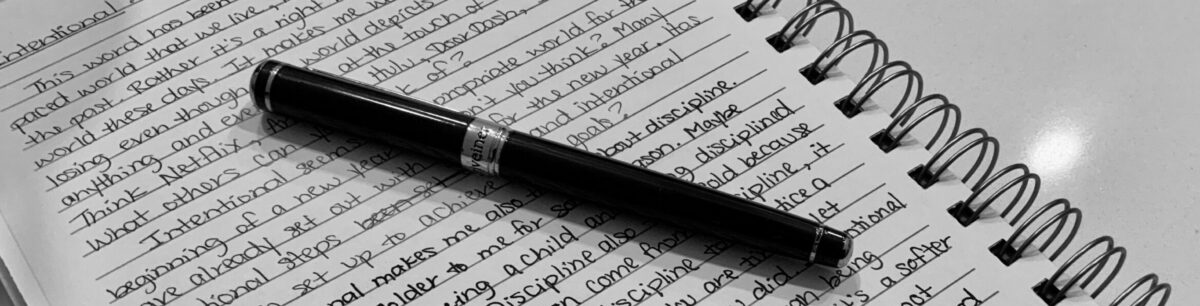
If you don’t already, I recommend keeping a journal. I don’t write in my journal every day. I don’t even write in it every week. However, it has been a practice in my life over the years. And, it has proven to be a powerful tool.

  1. It allows the processing of thoughts and feelings.
  2. It provides the opportunity to go back and read through experiences at different points in time.
  3. It’s a tool that helps you reflect on your mindset during past hardships.
  4. It helps you remember how things turned out.
  5. Reflection is a powerful tool. Hindsight is 20/20 after all.
  6. Journaling is a map that tells you where you’ve been and how far you’ve come. It helps you hold yourself accountable for how you got to where you are. It also helps you decide what you’d do differently, if anything.
  7. Reviewing the words you wrote during a hardship will remind you later of your strength.
  8. Articulating in written words helps your brain think more clearly.
  9. It gives swirling thoughts a home.
  10. It helps make clear what is unclear.
  11. It helps you navigate challenges.
  12. Keeping a journal slows you down. The world is so loud, busy, and fast. It’s easy to lose yourself in it all. One day you look up and don’t remember how you got where you are. If we aren’t careful, life passes us by without our permission.

Your Turn! Journal Prompt

A journal is a great way to check in with yourself periodically. Put 10 minutes on the timer on your phone. Spend those 10 minutes answering the questions below.

  • What is the biggest challenge you’re facing right now?
  • How would you like for it to turn out?
  • What can you do about it?
  • What is the right next step?

If you are looking for another resource that will simultaneously help you pray, journal, and listen for God’s voice; I highly recommend the book, Living Fearless by Jamie Winship.

*Another article coming soon about Leadership and Journaling.*

Battling the Hard Parts of Life with Therapy

Battling the Hard Parts of Life with Therapy

May – Mental Health Awareness Month

May is Mental Health Awareness month, and I would like to share my journey with therapy with you. You might recall the Career Confessions series I wrote recently. Part of the “confession” was my struggle with anxiety. Early on, it interfered with my work and job search. 

Why Therapy?

The journey with therapy, however, started for me in college. A visit here and there to the on-campus therapist was grounding. At the time, my mom had cancer and being away from home for this first time was hard. I had tough life questions. The therapist on campus helped me zoom out and then zoom in to the questions. This process allowed me to have a more balanced thought process. How many times are we so focused on a question or situation? We can’t zoom out from it to gain a better perspective. For me, it’s often. 😊 A therapist can help with that! 

Therapy Journey

A large part to my therapy journey is about my mom. She was sick much of my childhood. I was one of her caretakers while growing up. I was a primary caretaker from the ages of 15 – 18 (until I went off to college). I grew up fast! I was nominated as “Most Dependable” my senior year of high school. While it was an honor to receive that nomination, I earned it in my private home life. I learned the ultimate dependability by being my mom’s caretaker. 

There are a lot of positives that come from learning responsibility at a young age. However, it can also be very confusing. Caretaking an adult is hard for an adult let alone a child doing so. At the age of 25, my mom passed away. She was 55. I don’t think anyone is prepared to lose a parent. Losing my mom unearthed some “life stuff” I needed to address. I sought out therapy to talk through my mom’s death. There was a lot of processing I needed to do. Sometimes we are so close to a situation that we can’t see the full picture. A therapist can help with that. 

Therapy = Advocacy

I have learned through therapy that my mother’s sickness shaped me, both good and bad. The good is easier to hold some days than the bad. It’s easy to become fixated on one or the other. The point of therapy is to help you hold or see all aspects about yourself. At first, if you struggle with doing this, your therapist is there to help you until you are able to do it on your own. This is where advocacy comes into play and why it means so much at my core. My therapist has been my advocate in so many ways. Giving words to situations when I had none. She gave me a voice when I didn’t have one. And she has been there to hold my hand in all the hard things that I’ve been through. I can honestly say I would not be here right now if it weren’t for the gift of therapy. It has been life-changing. I have learned life-changing skills in therapy from navigating difficult relationships, to work challenges, to having compassion for myself. And having compassion for yourself is key to having compassion for others. Looking in the mirror, in my opinion, can be the biggest adversary you face. I know it has been for me. I can certainly stand in my own way. Therapy can help you get out of your own way! 

Life is Short

Therapy is hard, not going to lie. I don’t always like my therapist. She pushes me to look at the hard parts of life. She encourages me to talk about and process them too. Therapy has given me centeredness, truth, and grounding that is priceless. Maybe I would have gotten to this place on my own. Even if I had, it would have taken me so much longer. And don’t we deserve to get to a better place in life as fast as we can? Life is a vapor, James 4:14.  

Work on Yourself…for You and Others

A wise friend told me once, “Our work on ourselves is a lifetime and one day.” This means we are always inching toward being better versions of ourselves. Another quote that resonated with me: “The more we can understand our own thoughts, feelings, and emotions, the more we can understand someone else’s.” This is so true! The better you can see yourself, the better you can see others. There’s certainly more I could write about, but I will pause here. I hope this helps you seek a therapist if you’ve been thinking about it. And if you’ve never thought about it, I hope this helps you see a different side to therapy. I think we could all use a good therapist in our lives. Life is hard enough, and we deserve to be better people, for ourselves and each other. 

New Year Perspective

Happy New Year! A clean slate, a turning of the page, a new chapter, a new book. For some, 2024 may have been unusually difficult and you might be looking forward to the start of a new year. For me, I’m always a little concerned when midnight strikes on December 31. I’m worried about the unknowns and what hardships are in store. Will there be happiness, sadness, excitement? What losses might I experience? My logical brain knows that all of these will be true. My heart, on the other hand, is worried about the possibilities that will be hard and disappointing.

The truth is every year has challenges, losses, excitement, fun, sadness, happiness, and every other shade of emotion. In God’s wisdom, He did not give us a crystal ball to know what’s coming, instead time unfolds one day unto the next. Deuteronomy 31:8 says “The Lord himself goes before you and will be with you; he will never leave you nor forsake you. Do not be afraid; do not be discouraged.” It’s a comforting reminder that He walks with us daily. We will walk through hardships one step at a time much like any challenge we’ve already walked through, and we are never alone.

As we begin 2025 with goals, aspirations, or have hope of what this year will bring, I want to share a story I heard many years ago. It’s a story that stepped on my toes and caused me to reflect on the differences of what I’m looking for, what I may find, and the disconnect between the two.

Here’s the story: A farmer was tending his crops and a man came walking along the road. The man stopped and asked the farmer, “What kind of people are in the next town?” The farmer replied, “what kind of people were in the town that you came from?”

The man replied, “they were nice and kind people.” The farmer said, “you will find the same type of people in the next town.” And the man departed on his way.

Some time passed and the same farmer was tending his crops and another man was walking along the road and approached the farmer. He told the farmer he was travelling into the next town and he asked, “what kind of people reside there?”

The farmer asked, “what kind of people were in the town that you came from?”

The man replied, “oh, the people in the previous town were unkind, unfair, and judgmental which is why I left.” The farmer stated, “you will find the same type of people in the next town.”

What does this story illustrate? If you’ve experienced similar challenges and frustrations year after year, it might be an opportunity to reflect on what you are looking for and expecting to find. If you are anticipating hardship in 2025, you will find it. If you are suspecting that 2025 will be challenging, you will find it. Scientifically, our brains are wired to look for the evidence of what we believe. What do you honestly believe about this new year at your core?

What I know to be true is that I cannot bring the same thought processes and habits if I want something different. I can’t expect to grow friendships if I don’t plan and invest time into those relationships. I can’t expect to become healthier if I don’t plan how and when I’m going to be physically active and eat healthful foods. I’m setting myself up for frustration if nothing changes. It’s, then, easy to assume that it must be the outside world that’s not working. If I take a few steps back and zoom out, I can see the common denominator in frustrations that have seemly repeated in my life is me. If I want change, I need to shift my approach.

If you are frustrated that 2024 didn’t go so well, take a look at the things that you might be able to change in 2025, like your attitude and what do you honestly believe. What are you expecting to find in 2025? If it’s negative, then it might be time to reflect on how you can shift to more positive expectations. If you have goals you want to accomplish, make sure you aren’t standing in your own way to complete them. You, ultimately, hold the answers. Start with being honest with yourself and decide if it might be time to make a shift.

You can positively affect the direction of your 2025. You can accomplish your goals with the right mindset. Are you ready to crush 2025 and have an awesome year? Ready, set…let’s GO!